Insights

Why Most Businesses Overestimate What AI Can Do in Year One
Business team planning AI adoption strategy with guidance from Studio Graphene

Most organisations start their AI journey expecting too much too soon. They assume AI will automate complex decisions, replace major workflows or instantly transform productivity. In reality, success is almost always about laying foundations, not delivering miracles. We see this often: teams arrive frustrated that the hype doesn’t match what they experience in practice.

The gap comes from misunderstanding what AI is capable of today. Models are strong at pattern recognition, summarisation and structured decision support, but they struggle with ambiguity, missing data, organisational silos and workflows that weren’t designed for automation. Businesses often try to apply AI to messy, cross-team processes and are surprised when results are inconsistent. The problem isn’t the technology - it’s the starting point.

Year one should be about learning how to adopt AI safely and systematically. That means understanding where AI genuinely adds value, improving data quality, mapping workflows, setting guardrails and getting comfortable with probabilistic outputs. It’s a period of building muscle memory: defining success, reviewing outputs, catching edge cases and understanding what “good enough” looks like in practice.We help teams establish this rhythm so early missteps don’t slow adoption later.

The mistake many companies make is assuming transformation comes from a single large initiative. It doesn’t. Real progress comes from dozens of small, compounding improvements - each scoped tightly, tested quickly and expanded only when it proves reliable. Teams that follow this approach end up with working models in production, clear operating patterns and strong internal trust. Those chasing headline grabbing ideas often finish with prototypes that couldn’t scale.

The organisations that succeed with AI treat year one as a capability building cycle, not a BHAG. They invest in foundations, start small and let evidence guide ambition. With the right scaffolding in place, year two and three deliver the big wins - not because the technology suddenly improves, but because the organisation finally knows how to use it.

At Studio Graphene, we work alongside teams to reduce risk, reset expectations and build the operating rhythm that leads to genuine, long-term AI impact. By focusing on foundations first, businesses can turn early experimentation into sustainable growth and lay the groundwork for AI to deliver measurable results in the years ahead.

spread the word, spread the word, spread the word, spread the word,
Developer experience as a measure of software delivery performance.
Development

Developer Experience Is a Delivery Metric

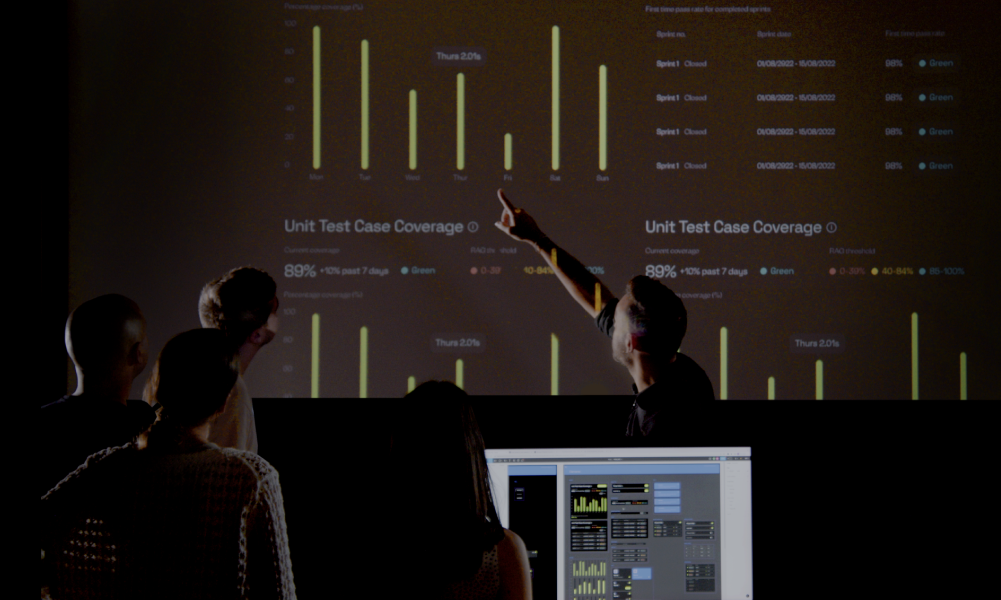
People analysing Pulse delivery performance data displayed on a large screen, with laptops in front of them.
AI

We Built an MCP Server for Pulse and Stopped Building Our Chatbot

Measuring the impact of agentic development on software delivery, from developer effort and code quality to team throughput.
AI

How Do You Know Agentic Development Is Making Delivery Better?

Diagram illustrating Studio Graphene’s multi-agent code review workflow, with separate agents checking code quality, security and engineering standards before findings are challenged and reviewed by an engineer.
AI

Can AI Agents Really Review Each Other’s Work?

Illustration representing AI agents writing code alongside developers overseeing the software development process and making key engineering decisions.
AI

When AI Agents Write the Code, What Do Developers Actually Do?

Developer Experience Is a Delivery Metric

Developer experience as a measure of software delivery performance.
Development

Developer Experience Is a Delivery Metric

We Built an MCP Server for Pulse and Stopped Building Our Chatbot

People analysing Pulse delivery performance data displayed on a large screen, with laptops in front of them.
AI

We Built an MCP Server for Pulse and Stopped Building Our Chatbot

How Do You Know Agentic Development Is Making Delivery Better?

Measuring the impact of agentic development on software delivery, from developer effort and code quality to team throughput.
AI

How Do You Know Agentic Development Is Making Delivery Better?

Can AI Agents Really Review Each Other’s Work?

Diagram illustrating Studio Graphene’s multi-agent code review workflow, with separate agents checking code quality, security and engineering standards before findings are challenged and reviewed by an engineer.
AI

Can AI Agents Really Review Each Other’s Work?

When AI Agents Write the Code, What Do Developers Actually Do?

Illustration representing AI agents writing code alongside developers overseeing the software development process and making key engineering decisions.
AI

When AI Agents Write the Code, What Do Developers Actually Do?

Developer Experience Is a Delivery Metric

Developer experience as a measure of software delivery performance.

We Built an MCP Server for Pulse and Stopped Building Our Chatbot

People analysing Pulse delivery performance data displayed on a large screen, with laptops in front of them.

How Do You Know Agentic Development Is Making Delivery Better?

Measuring the impact of agentic development on software delivery, from developer effort and code quality to team throughput.

Can AI Agents Really Review Each Other’s Work?

Diagram illustrating Studio Graphene’s multi-agent code review workflow, with separate agents checking code quality, security and engineering standards before findings are challenged and reviewed by an engineer.

When AI Agents Write the Code, What Do Developers Actually Do?

Illustration representing AI agents writing code alongside developers overseeing the software development process and making key engineering decisions.