Insights

AI‑Native in Action: Small Steps You Can Take This Quarter

Team using AI tools collaboratively at a digital product studio

For teams starting to bring AI into daily practice, it’s easy to feel overwhelmed. People know AI could help but aren’t always sure where to start or how to fit it into existing workflows. Without structure, projects stall, insights get lost and experiments rarely scale.

A simple way forward is to focus on small, immediate actions. Treat every AI decision like a code commit - record what changed, why and what impact it had. Reuse prompts, tests and evaluation sets across products to save time and maintain consistency. Run short, timeboxed experiments with rollback paths by default - it’s safer, faster and lets teams iterate with confidence.

Connecting semi-disjointed systems is another quick win. Pull data from CRMs, project tools and finance platforms into a single view so insights aren’t trapped in silos. Even small improvements here reduce wasted effort and help teams make better decisions.

Getting started this quarter could mean assigning clear model owners, defining simple runbooks, running brief exception reviews and cataloguing live AI use cases. These are not huge projects. They’re small steps that gradually make AI part of everyday workflows without adding extra complexity.

The real power comes from compounding these small wins. Each experiment, connected system and reused prompt builds momentum, creating a rhythm where AI isn’t something extra - it’s just how work gets done. Teams become more confident, more curious and better at spotting opportunities to improve processes and products with AI.

Embedding AI this way also shifts the conversation from “how can AI help us?” to “how does AI fit into what we already do?” It turns abstract ideas into tangible improvements, builds shared understanding across teams and gives leaders clear evidence of where AI is adding value. Focusing on practical, low-friction actions first sets organisations up for longer-term transformation without the overwhelm.

At Studio Graphene we help teams make these actions real. Through workshops, templates and hands-on support we guide organisations to embed AI-native practices incrementally, so AI becomes a natural part of daily decision making rather than a separate project. Small steps, repeated consistently, lead to smarter, faster and more confident teams.


spread the word, spread the word, spread the word, spread the word,
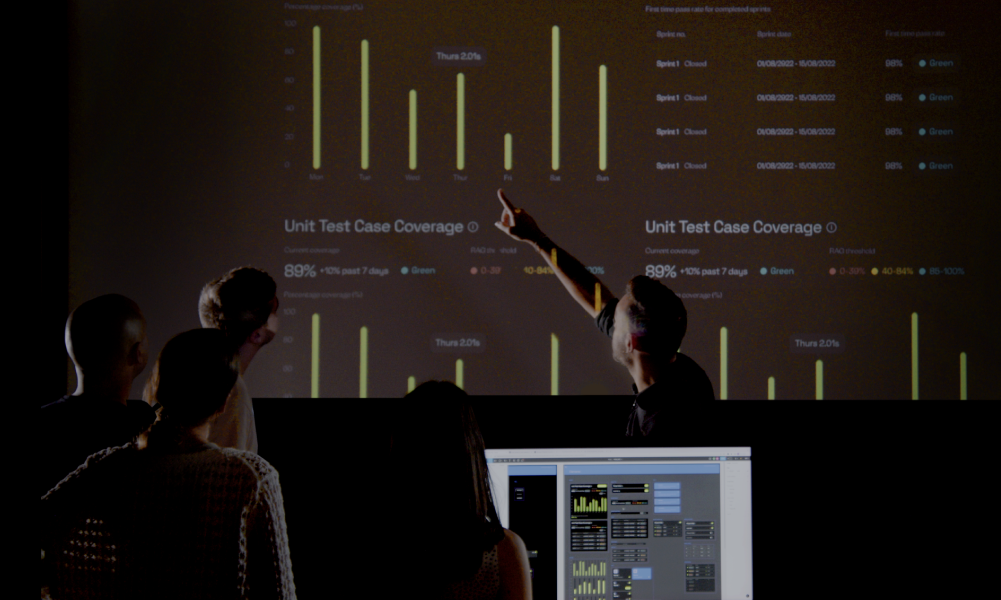
People analysing Pulse delivery performance data displayed on a large screen, with laptops in front of them.
AI

We Built an MCP Server for Pulse and Stopped Building Our Chatbot

Measuring the impact of agentic development on software delivery, from developer effort and code quality to team throughput.
AI

How Do You Know Agentic Development Is Making Delivery Better?

Diagram illustrating Studio Graphene’s multi-agent code review workflow, with separate agents checking code quality, security and engineering standards before findings are challenged and reviewed by an engineer.
AI

Can AI Agents Really Review Each Other’s Work?

Illustration representing AI agents writing code alongside developers overseeing the software development process and making key engineering decisions.
AI

When AI Agents Write the Code, What Do Developers Actually Do?

From AI-Assisted Coding to Agentic Software Development | Studio Graphene
AI

From AI-Assisted Coding to Agentic Software Development

We Built an MCP Server for Pulse and Stopped Building Our Chatbot

People analysing Pulse delivery performance data displayed on a large screen, with laptops in front of them.
AI

We Built an MCP Server for Pulse and Stopped Building Our Chatbot

How Do You Know Agentic Development Is Making Delivery Better?

Measuring the impact of agentic development on software delivery, from developer effort and code quality to team throughput.
AI

How Do You Know Agentic Development Is Making Delivery Better?

Can AI Agents Really Review Each Other’s Work?

Diagram illustrating Studio Graphene’s multi-agent code review workflow, with separate agents checking code quality, security and engineering standards before findings are challenged and reviewed by an engineer.
AI

Can AI Agents Really Review Each Other’s Work?

When AI Agents Write the Code, What Do Developers Actually Do?

Illustration representing AI agents writing code alongside developers overseeing the software development process and making key engineering decisions.
AI

When AI Agents Write the Code, What Do Developers Actually Do?

From AI-Assisted Coding to Agentic Software Development

From AI-Assisted Coding to Agentic Software Development | Studio Graphene
AI

From AI-Assisted Coding to Agentic Software Development

We Built an MCP Server for Pulse and Stopped Building Our Chatbot

People analysing Pulse delivery performance data displayed on a large screen, with laptops in front of them.

How Do You Know Agentic Development Is Making Delivery Better?

Measuring the impact of agentic development on software delivery, from developer effort and code quality to team throughput.

Can AI Agents Really Review Each Other’s Work?

Diagram illustrating Studio Graphene’s multi-agent code review workflow, with separate agents checking code quality, security and engineering standards before findings are challenged and reviewed by an engineer.

When AI Agents Write the Code, What Do Developers Actually Do?

Illustration representing AI agents writing code alongside developers overseeing the software development process and making key engineering decisions.

From AI-Assisted Coding to Agentic Software Development

From AI-Assisted Coding to Agentic Software Development | Studio Graphene